
Reviewed · RIBEIRA & OLD TOWN
Cruise Shore Excursion – Private Tuk Tuk Tour to the Historic Center
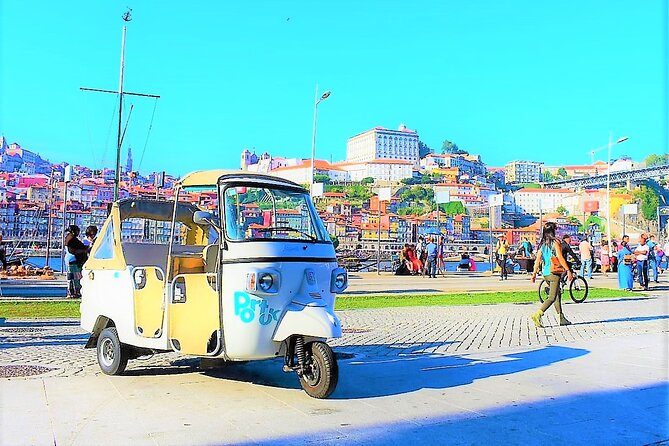
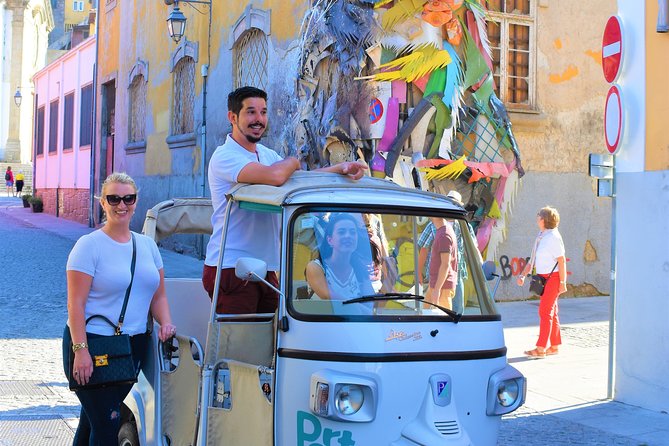
Porto’s hills demand a tuk tuk. This private 3.5-hour shore excursion uses small streets and smart stops to give you Porto’s highlights with easy river views from the comfort of a tuk tuk. You get English commentary, pickup from the cruise port area, and a plan that keeps you moving without feeling like you’re rushing through everything.
I love how you get to see big-name sights like Torre dos Clérigos and Livraria Lello without the usual bus stress. I also love the human touch, the way guides like Ana, Anna, and Gonçalo mix history with practical tips for what to notice and how long things take. One heads-up: the tuk tuk is built for a small group (often two), and cobblestones plus limited shopping time can feel like a tradeoff.
Key highlights at a glance
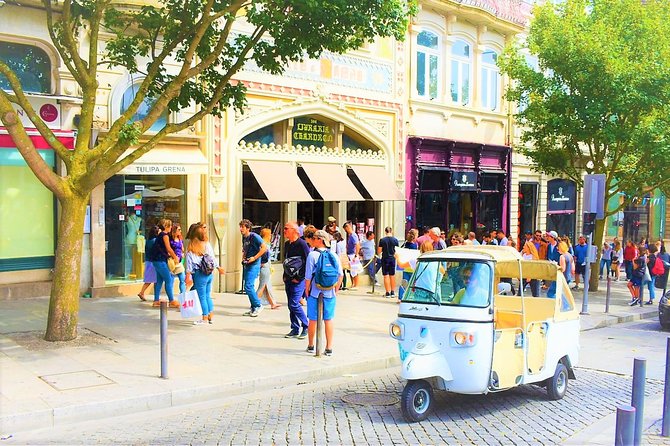
- Tuk tuk access in narrow, hilly streets where buses cannot go
- Best-of Porto arc from river viewpoints to iconic churches in about 3.5 hours
- Multiple photo-worthy stops including Clérigos Tower area and the Lello exterior
- Port wine tasting included, usually served at a lookout point
- A guide who times it right, helping you see more than you could on foot
How the private tuk tuk feels in Porto
This tour is all about getting your bearings fast. Porto is steep, the streets are tight, and the angles matter. A tuk tuk lets you glide into parts of the historic center that feel off-limits for normal cars and most buses, so you spend less time fighting cobblestones and steep climbs.
The ride is also a good match for a first visit. You get a “greatest hits” sweep with enough stops that you can later decide what to explore in depth on your own. In the best case, you end the tour already knowing which neighborhood you want for dinner, which viewpoint you want to revisit, and which sights you’d like to go inside.
Small vehicle reality check: the tuk tuk is compact. If you’re traveling as more than two, you may feel a little cramped. One more practical note, Porto’s center has cobblestones, and a short ride can still feel bumpy. If you’re sensitive to that, sit where you feel most stable and take it slow when you get off.
You can also read our reviews of more boat tours in Porto


Pickup from Leixões, Matosinhos, and Doca Norte
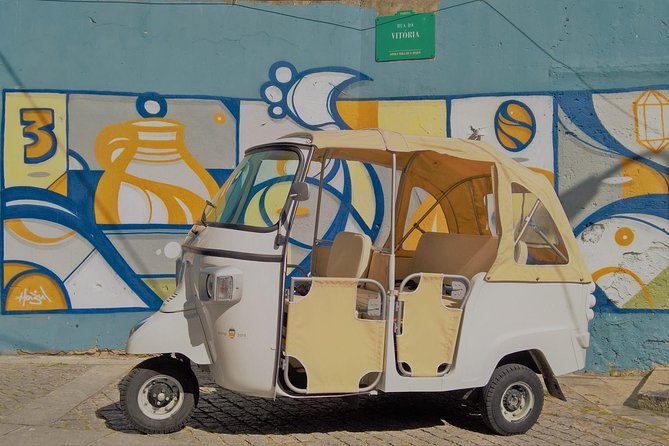
The pickup system is built for cruise timetables. You’re collected from the main gate at Leixões Port, Matosinhos Port, and Doca Norte, and the tour begins no later than about an hour after your ship arrives.
That matters because Porto’s traffic and parking can turn a shore day into a puzzle. Starting with a timed pickup means less wandering around the port area and more time in the historic center where you want to be. And the tour ends back at the meeting point, so you are not solving your own way back while you’re thinking about reboarding.
If your ship docking time shifts, you’ll want to be ready to match the operator’s messaging so you do not lose time. One strong theme from the experience is how much smoother the day goes when the guide meets you quickly and gets you rolling.
The seafaring sculpture and granite tower stop: Porto’s industrial roots
Right away, you start seeing Porto as a working port city, not just a pretty postcard. One early stop is a sculpture designed to reflect Porto and Matosinhos’ seafaring and industrial heritage. The details are the point here, the painted support poles that resemble smokestacks and lighthouses, and the net-like structure that nods to fishing.
Next comes a granite tower with a red balcony and lantern, plus a small annex building with white plastered walls. It’s the kind of stop that lasts only a few minutes, but it gives you context. You begin to notice how Porto’s architecture mixes utilities, symbolism, and craft.
If you’re the type who likes to understand what you’re seeing, these early moments help. They set up the rest of the tour, where the city’s maritime energy and religious power show up side by side.
The garden with fountains, obelisks, and that 1874 romantic chalet
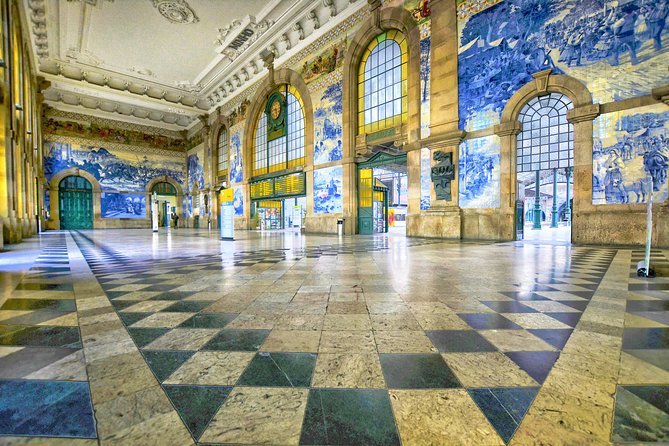
Porto has formal gardens that feel like curated worlds. In this tour, you visit a large garden area that was laid out with landscaping involvement from Emíle David and includes a set of architectural features tied to different places in the city.
What I like here is the variety packed into a single place:
- A granite fountain and features linked to the old S. Francisco Convent
- Nasoni obelisks and other restored elements
- A small romantic chalet built in 1874, before the final garden completion
- Even a miniature golf course, plus a bandstand that hosts concerts occasionally
- And yes, a public bathroom built in 1910 with Art Nouveau tiles and English finishings
This is a great “breather” stop. After walking and climbing around viewpoints, a garden pause resets your legs and your head. Also, garden settings make it easier to take photos without feeling like you’re standing in a crowd.
Arrábida Bridge and Passeio das Virtudes: river views that feel effortless
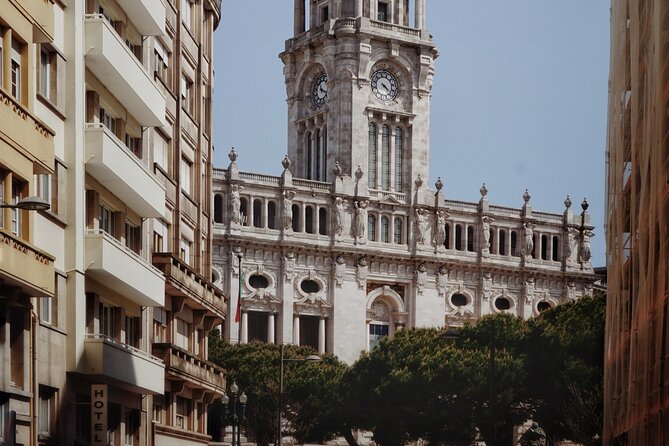
Porto’s river is not a backdrop, it’s the storyline. The tour includes the Arrábida Bridge, an important concrete arch bridge engineered by Portuguese engineer Edgar Cardoso. It was inaugurated in 1963, and at the time it was noted as a record for concrete-arch spans.
Then you move to Passeio das Virtudes. This viewpoint lane gives an excellent look down toward the Douro river mouth bar. You also see the Fountain of Virtudes and terraces that step down toward São Pedro de Miragaia. Along the way, you can spot the imposing former Customs House building.
Here’s the practical value: you get the big geography of Porto explained while you’re standing where it makes sense. If you want to return later to specific river-side streets, this stop helps you pick where to go and why.
Compare more private Porto tours with a guide in Porto


Clérigos Tower area: the skyline payoff, with an easier option
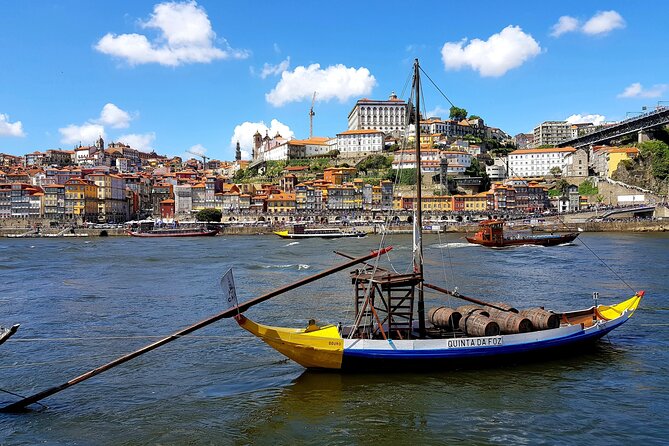
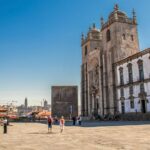
Torre dos Clérigos is one of Porto’s most emblematic monuments. It’s a Baroque work by Nicolau Nasoni, built in the first half of the 18th century, and it’s famous for the panoramic views from the top after a climb up 240 steps.
The tour also highlights an alternative for people who do not want the full climb. The complex includes a multi-sensory experience that simulates the ascent. That means you are not totally shut out if stairs are tough for you.
If you love views, this is a must on the “see it once” list. If you prefer to save your energy for walking elsewhere, the simulation option can still give you the sense of the experience without the steep climb.
Cordoaria Garden, rope-maker history, and the João Chagas backstory
Another free stop is Jardim de João Chagas, also known as the Cordoaria Garden. It’s named after João Chagas from 1924, but the deeper story is about rope-makers who stayed there for around 200 years.
The garden was created as a municipal transformation of the Praça da Cordoaria into a public space, based on landscaping by Emile David in the 1860s. You’ll see statues of Ramalho Ortigão and António Nobre, plus sculptures connected to later cultural projects.
This is one of the stops that makes the tour feel more like a cultural orientation than a checklist. It’s quieter than the famous churches, and you come away understanding how Porto’s craft and trade fed into everyday city life.
Portuguese Centre for Photography: a prison turned into culture
One of the most interesting architecture stops is a polygonal granite building dating to 1582 and rebuilt in 1767 in a neo-classical style. The building has a geometric pattern of 103 windows and multiple façades linked to its main functions.
It also has a heavy historical layer. The other façade, opened toward the Cordoaria Garden, was connected to the direct passage of prisoners. Two names come up in the story, Camilo Castelo Branco and Zé do Telhado, both linked to incarceration.
Between 1999 and 2002 it was restored under the direction of Eduardo Souto de Moura and Humberto Vieira, and it now functions as the Portuguese Centre for Photography. If you like “how a place changes,” this stop offers a sharp contrast between old purpose and new use.
Livraria Lello: Art Nouveau drama, and the line reality
Livraria Lello is famous for a reason. The building was inaugurated in 1906, with a detailed Art Nouveau façade and neo-Gothic elements. Inside, the library has painted plaster that imitates wood, plus a major staircase connecting floors. The skylight is huge and stained glass, with the library’s monogram and motto Decus in Labore.
Practical truth: entrance is not included in the tour, and the lines can get long. If going inside is a priority, plan your ticket timing ahead. One simple tactic is buying skip-the-line access online so you do not lose your place when time is tight.
Even if you only see it from outside, the façade is an easy photo target and it helps you understand why Porto feels like it has “layers” of different eras.
Carmo and Carmelitas churches: tiles, rococo, and Nasoni vibes
Porto’s church interiors can be an adventure, and this tour includes two rococo-focused stops.
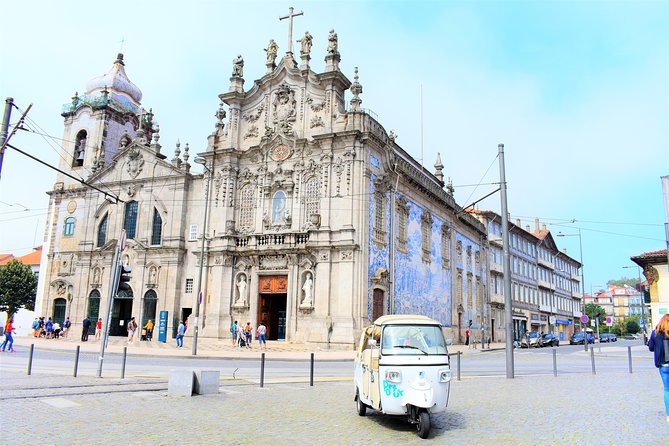
Igreja do Carmo is from the second half of the 18th century, with an interior known for rococo carvings. In 1912, the side façade received tilework, with drawings designed by Silvestre Silvestri. The tiles reference the cult of Nossa Senhora, Our Lady.
Then you have Igreja dos Carmelitas, a 17th-century church with a classical façade dating from the 1850s. The project has been attributed to architect and painter Nicolau Nasoni. The altarpiece is Porto rococo in style and is described as stylistically revolutionary.
These are short stops, so I’d use them as “spot and select” moments. Notice the façade details, then decide later if you want to return for more time inside.
Igreja de São Francisco: the gilded interior and the catacombs
This is the big Gothic temple stop. Construction began in the 14th century, and it became famous for the exuberant gilded interior from the 17th and 18th centuries. The church is often called the Church of Gold, and the tour’s framing puts you in the mindset to look for the key features rather than just the overall wow.
Pay attention to the Tree of Jesse and the catacombs. The church is a National Monument since 1910 and was recognized by UNESCO in 1996 as part of the World Cultural Heritage context.
Entrance is not included here. If you want to go inside, keep in mind that it’s a “time cost” stop. The payoff is that this church can feel like you’re stepping into a different tempo, slower, more ornate, and more tactile than the streets around it.
Fonte dos Leões, Ribeira fountain, and Praça da Ribeira nightlife zone
Porto likes symbols in public spaces, not just in museums. Fonte dos Leões, the Fountain of the Lions, is a 19th-century fountain built by a French company, with casting from the Val d’Osne foundry in France. It’s a copy in most parts of a fountain in Leicester, England, which is a fun reminder that art and design traveled.
Then you get into Praça da Ribeira, one of the oldest squares in the city. It used to be a medieval commercial center with fish market activity, and it was remodeled in the 18th century using revenue from wine. A 17th-century fountain was discovered during archaeological work in the 1980s and reconstructed in its original location, crowned with a sculpture known popularly as the Cube of the Ribeira. A statue of St. John the Baptist was unveiled in 2000.
One note: this area is closed to vehicles. That can actually be a win, because it makes the walking feel safer and less chaotic, especially if you’re hopping between waterfront spots.
Palácio da Bolsa and Mercado Ferreira Borges: power and iron architecture
Two big architecture landmarks anchor a large historic-center moment.
Palácio da Bolsa, the Stock Exchange Palace, is a National Monument designed in neoclassical style in 1842 by Joaquim da Costa Lima. It’s tied to Porto’s Commercial Association and is famous for the Arabian Room. It is also part of the Urban Wine Route, and there’s an accessibility option via a side entrance.
Nearby, Mercado Ferreira Borges reflects another kind of power: iron architecture. Built in 1885 to replace an older market, it had a short period as a true market and later shifted roles. Today, it functions as an entertainment venue, with Hard Club now located there.
If you want to understand why Porto’s old town still feels modern, these stops help. One is finance and formal design. The other is engineering and adaptive reuse.
The world-class iron bridge experience: two decks, one view
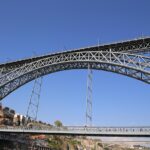
You also pass the famous iron bridge of Porto, planned by engineer Teófilo Seyrig, who was a disciple of Eiffel. Inaugurated in 1886, it has two overlapping iron decks. The bridge is 395 meters long and 8 meters wide, and at completion the arch was described as the world’s biggest forged iron arch.
Today, the Metro uses the upper deck, connecting the Cathedral area to the Garden of Morro and the Avenida da República in Vila Nova de Gaia.
This is the moment to look up and around, not just across. Even a brief stop helps you see how Porto’s infrastructure ties into its waterfront streets and how the city’s daily movement still shapes what you notice as a visitor.
Serra do Pilar monastery and the elegant view over Porto and Gaia
Mosteiro da Serra do Pilar is a World Cultural Heritage site and it offers the terrace view that makes Porto feel cinematic. The building began in 1538 and was completed around 1670, first serving Augustinian Friars. During the Civil War of 1832 to 1834, the liberal army settled there, and the building fell into disrepair.
It was recovered in stages, with major restoration linked to the Royal Brotherhood of Lady of the Pilar and later the Group of Friends of the Monastery of Serra do Pilar in 1925. The church is circular with a dome and balcony, and the cloister has 36 Ionic columns, noted as the only example of its kind in Portugal.
From the terrace, you can see across the riverside toward Porto and Gaia, plus the Arrábida Bridge, the historic center, and the Cathedral and D. Luís I bridge. In the other direction, you can see Fontainhas and the São João bridge.
This stop is valuable because it helps you “map” what you’ve already seen. After this, everything else feels less random.
The modern bridge finale: Porto’s engineering flex
To close the loop, you also get the newer bridge connection. The bridge was inaugurated March 30, 2003, designed by engineer Adão da Fonseca. It replaced the upper deck lane of D. Luís I bridge, where the metro line now runs.
It is a Maillart-type arch bridge with a 371-meter-long deck and a 20-meter width, and its arch span of 280 meters was noted as a world record at the time. Experts also regard it as one of the most elegant examples of this type.
It’s not just engineering trivia. It’s a reminder that Porto is not only old stone and tiled façades. The city kept building while it kept preserving.
Port wine tasting: a small included moment you should treat as a warm-up
Alcoholic beverage is included, a Port wine glass. In practice, it’s usually served during a viewpoint moment rather than as a full sit-down stop.
That matters for time. You can taste and keep moving, which fits a shore day. If you like Port, this small taste is a good prompt for later, when you might want a longer sampling session on your own.
Guides also tend to connect the wine moment to where to eat next. If lunch is on your plan, ask for suggestions while you’re still in the middle of the tour, so you can factor in your walking time back to the ship.
Price and value: what you pay for on a cruise day
At $106.93 per person for about 3 hours 30 minutes, you’re paying for three things: private transportation, live guided commentary, and curated access to a lot of highlights without you doing the hard logistics.
Is it “cheap”? No. But cruise shore days are short, and Porto’s hills and traffic can waste time fast. This tour is designed to reduce that waste. You trade a bit of flexibility for a strong orientation and an efficient route.
Also, several major sights have separate entrances, including Torre dos Clérigos and Livraria Lello, and the big church complex. That’s not a deal-breaker, but you should budget for it if you want to go inside the most famous spots.
Who should book this private tuk tuk tour
Book this if:
- You have limited time in Porto from a cruise stop and want a fast introduction
- You like history told in plain language, not a museum lecture
- You want viewpoints and iconic streets without doing all the steep walking
- You want a guide to steer you toward good lunch ideas and smart timing
Consider skipping it if:
- You need lots of shopping time between monuments
- You are hoping for a big-steps, long-museum, slow-and-deep itinerary
- You are traveling with more people than the tuk tuk can comfortably handle
Should you book it
If your goal is a high-quality first look at Porto in one afternoon, this private tuk tuk tour makes a lot of sense. The format is practical, and the stops are chosen so you see the city’s story, river setting, and architecture in a way that is hard to replicate on your own when you’re pressed by cruise schedules.
If you’re flexible about entrance fees and you plan ahead for places like Livraria Lello, you’ll get your money’s worth. If you want a slow stroll and lots of shopping, you may feel time is controlled for you.
FAQ
How long is the private tuk tuk tour?
It lasts about 3 hours 30 minutes.
Where do you get picked up for this Porto tour?
Pickup is from the main gate at Leixões Port, Matosinhos Port, and Doca Norte.
When does the tour start relative to my cruise arrival?
The tour starts no later than 1 hour after your ship arrives, and the activity starts within the hours listed for the experience.
Is this tour private?
Yes, it is a private tour for your group only.
Do I need separate tickets for monuments?
Monuments entrance is not included. Some stops are listed as free, but major sights like Torre dos Clérigos and Livraria Lello have separate admission.
Is Port wine included?
Yes. The tour includes a Port wine glass as part of the experience.
What kind of weather does the tour require?
The experience requires good weather. If it’s canceled due to poor weather, you’ll be offered a different date or a full refund.
More Boat Tours & Cruises in Porto

More Tours in Porto

More Tour Reviews in Porto
Keep comparing: recently reviewed experiences around Porto



Ribeira & Old Town, compared.
 ★ 5.0The Unvanquished Tour in Porto City CenterFrom $326,497 reviews
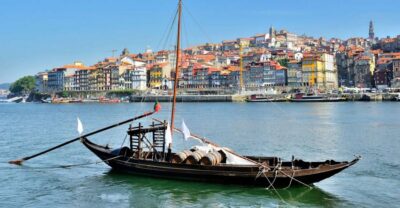 ★ 4.7Historic City Center Walking TourFrom $331,172 reviews
 ★ 4.8The highest-rated traditional fado concert (downtown)From $191,130 reviews
 ★ 4.8Historical Center Walking TourFrom $41898 reviews
 ★ 4.5Historic Porto by Private Electric Tuk Tuk to Top LandmarksFrom $42735 reviews
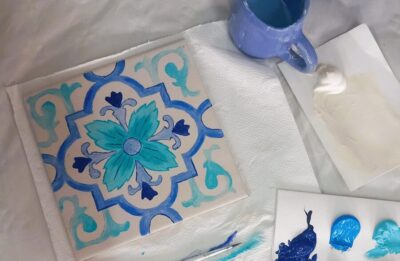 ★ 4.9Tile Painting and Cocktails in Downtown PortoFrom $41484 reviews
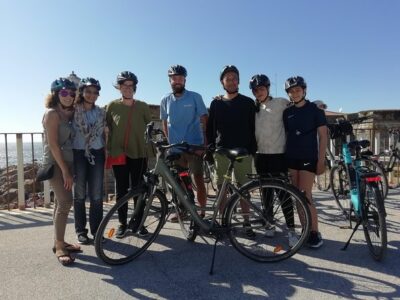 ★ 5.03-Hour Old Town & Riverside Bike Tour – Guided ExperienceFrom $47481 reviews
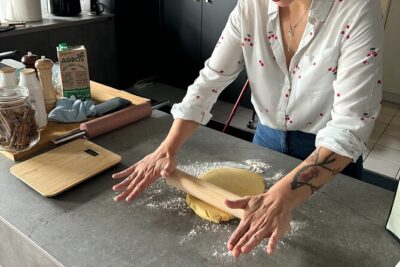 ★ 5.0Pastel de Nata | Workshop from scratch | Porto’s city centerFrom $48449 reviews
Browse the lists this tour appears in