
Reviewed · PRIVATE PORTO TOURS
Private tour to Ponte de Lima, Vinho Verde region
A small town, big bridge stories. This private day trip packs Ponte de Lima’s Roman-medieval core with the Vinho Verde wine region, plus tons of monuments you can see at a comfortable pace.
I really like two things here. First, the route makes sense visually, starting at the city’s iconic old bridge and then walking outward through towers, chapels, and churches right by the Lima River. Second, the tour style is practical and personal, and my guide, Carlos, took extra time when we wanted to linger, explained what we were looking at in plain language, and even shared restaurant ideas near where I’d be staying.
One consideration: a few of the more “wine-focused” stops have extra charges, and lunch is also an add-on. So if you want a very fixed budget, plan for tastings and pick one optional wine experience rather than everything.
Key things to know before you go
- Private transport that feels like a mini reset: luxury vehicle with Wi-Fi, bottled water, and refreshments
- Most monument stops are free: many sights on the route are listed with free admission
- A real taste of Vinho Verde: interpretation center visit includes wine promotion plus a tasting option with extra cost
- Historic Ponte de Lima, not a speed walk: the day is paced for meaningful stops
- Carlos-style guidance: extra time at your tempo, clear explanations, local restaurant tips
- Optional wine adds depth: Calheiros and Refoios choices let you go from sightseeing to cellar time
Why Ponte de Lima and Vinho Verde work so well in one day
Ponte de Lima is the kind of place that makes you slow down without forcing it. You start with the Lima River, see the town’s layered Roman and medieval footprint, then shift into Vinho Verde, a wine region that actually belongs to the landscape you’re walking through.
This tour works because it balances three things you can feel: history you can see up close, streets that are pleasant to walk in, and wine that fits the day instead of turning it into a long winery marathon. If you like your travel with fewer stress moments, the structure is a good match.
You’ll also notice the route is full of small landmarks that help you build a mental map fast. A bridge, a chapel near the old crossing, a church with distinctive tiles, towers that still define the skyline. It’s the opposite of a random checklist.
Compare more private Porto tours with a guide in Porto

Getting there in comfort from central Porto and Gaia
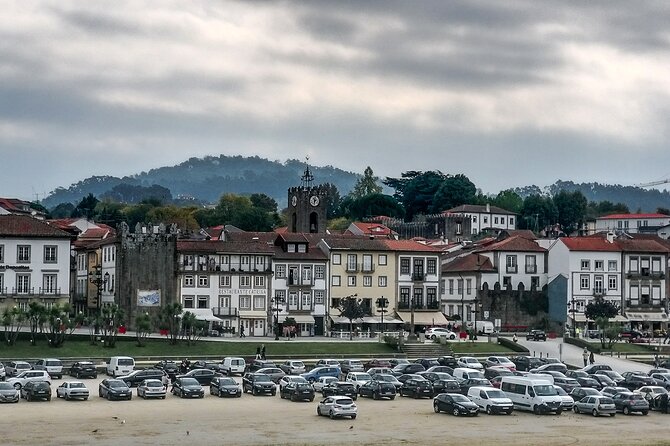
You’re picked up from hotels and B and Bs in central Porto and Gaia, with the day starting at 8:00 am. Since it’s private, your group controls the pacing, and you’re not juggling other people’s “one quick photo” habits.
Transport is in luxury vehicles with Wi-Fi, bottled water, and refreshments. That sounds like a marketing line, but it matters in practice, especially for an 8 to 10 hour day where you might want to recharge between photo stops. You also get personal accident and civil liability insurance as part of the package.
If you prefer a low-effort day, this is the easiest part to appreciate. You just show up, and the driving is handled.
Ponte Romana e Medieval: the bridge that shapes the whole town
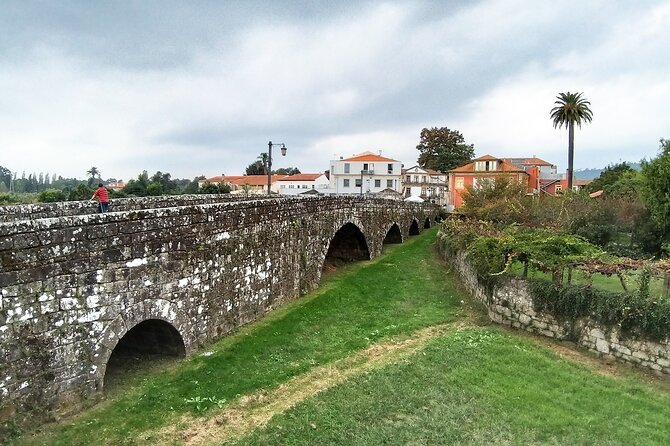
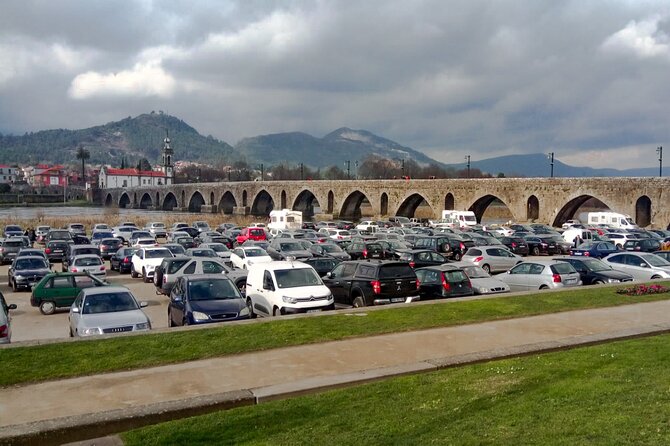
Stop one is the Ponte Romana e Medieval, Ponte de Lima’s real centerpiece. It’s not one single bridge, but a set of bridges. You can see a larger medieval section that connects from the left bank toward the Church of Santo António da Torre Velha, and then a Roman section with five arches starting from the great arch in the dry riverbed.
This is also a National Monument (declared in 1910), so you’re not just sightseeing something old, you’re looking at protected architecture that still defines how locals imagine their town.
What I like about starting here: it gives you context immediately. After the bridge, the rest of the sites feel connected, not scattered. You understand why the town’s streets and religious buildings cluster where they do.
Possible drawback: the bridge is iconic, so it can be busy at peak times. If you care most about photos and quiet, you’re still likely to get a calmer feel early in the day, but it’s worth knowing.
Capela do Anjo da Guarda and Santo António da Torre Velha
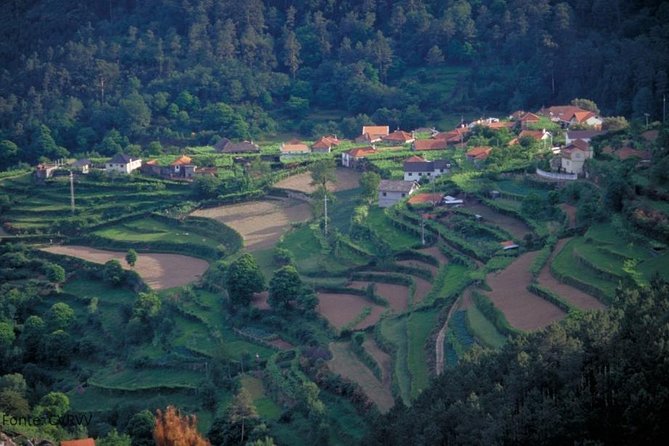
Right near the river and close to the Roman bridge section, you’ll reach the Capela do Anjo da Guarda, also known as Padrão de São Miguel. It’s classified as a National Monument (since 1978), and it may date from the 17th century. In 2021 it was restored, and the reopened intervention opened in March 2022, so it’s the kind of site that can feel fresh and cared for.
A short step later is Igreja de Santo Antonio da Torre Velha. This church links to an older hermitage tradition documented since the 18th century, dedicated to Nossa Senhora da Esperança, though today’s appearance reflects later reforms ordered by the Santo António confraternity. The tile panels are a big visual clue that you’re looking at a layered community, not just a single construction era.
Why this pair matters: you’re standing at the same historic zone and watching how religious buildings evolved next to the bridge. It’s an easy way to understand how Ponte de Lima used its river and crossings.
What to watch for: the church name itself, Torre Velha, connects to older medieval fencing structures, which helps explain why the area feels more “historic core” than “just another church.”
Vinho Verde at the Interpretation Center: film, vineyard terrace, and a tasting choice
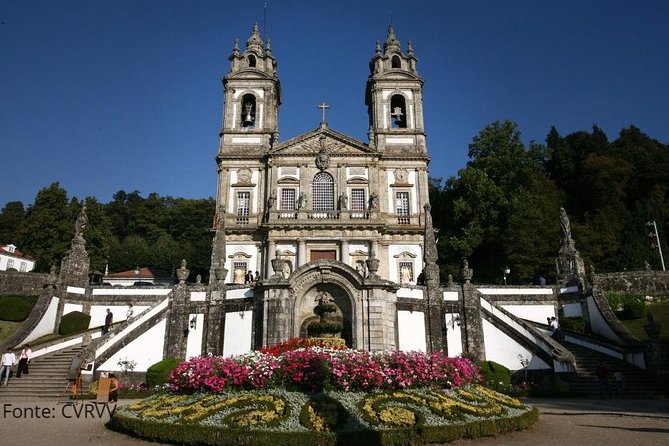
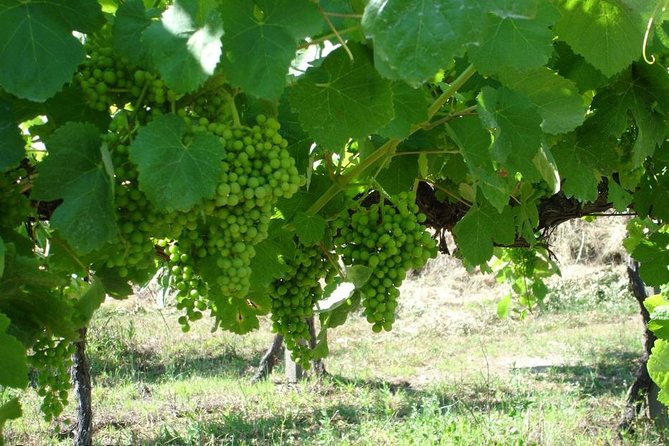
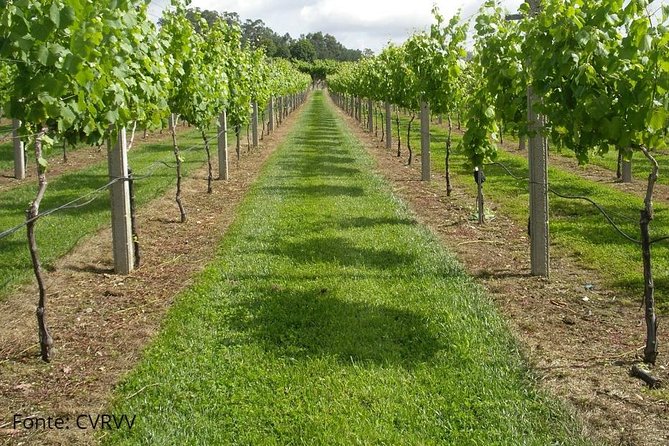
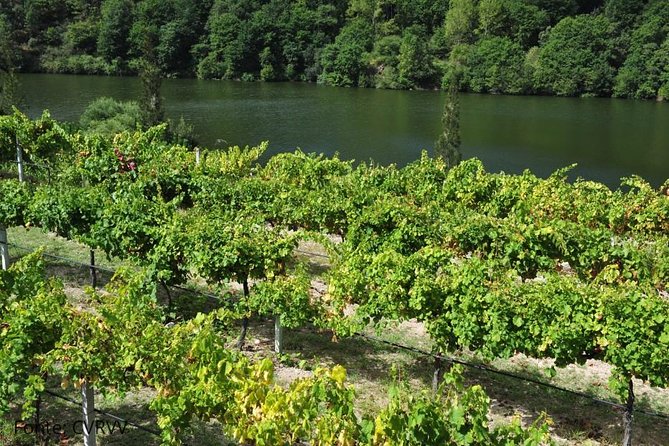
Next comes Centro de Interpretação e Promoção do Vinho Verde. The visit includes access to the permanent exhibition, time on a terrace with a small vineyard planting, and viewing a promotional film about the Demarcated Region of Vinhos Verdes.
Then there’s the wine tasting portion, which is not included in the standard access fee listed on the tour day. If you want the wine sample, you’ll pay the extra admission for the tasting, which is shown as €3 per person for the interpretation center proof/tasting.
What you get out of this stop: it translates the region into something you can picture. Instead of just drinking a wine somewhere else in Portugal, you’re learning what “Vinho Verde” means in terms of region identity, then looking at a tiny terrace vineyard that ties it back to the landscape.
Best for: this stop is great if you want a light wine introduction without committing to a full cellar schedule.
Skip consideration: if you’re already deep into wine research or want only a bigger tasting, you might see this as more “intro and ambiance.” Still, it’s usually a helpful stepping stone.



Taverna Vaca das Cordas: tradition near the Lima River
The Taverna Vaca das Cordas stop brings you to a tradition rooted in the 15th century. It’s tied to the eve of the religious holiday of Corpus Christi, typically late afternoon, and it draws people from across Portugal and even nearby Spain.
The “Vaca das Cordas” race starts on Rua do Arrabalde, heads toward Largo da Matriz, and fulfills the tradition of going around the church three times. From there it continues through the historic center, then to the beach area near the Lima River, where people try to dribble the animal or simply watch the show.
Important practical note: this tour can include the landmark area even if the actual festival moment isn’t happening on your day. So treat this as a cultural anchor, not a promise you’ll see the race in action.
Why I like this stop: it reminds you Ponte de Lima is a living town. Monuments are fine, but tradition is what keeps the streets from feeling like a museum.
Dona Teresa to the Matriz Church: a Gothic highlight in the town center
A quick hop brings you to the Estátua de Dona Teresa, honoring Queen D. Teresa who granted Ponte de Lima the charter of Vila in 1125. It’s a small stop, but it signals that the town’s story stretches far beyond the obvious bridge.
Then you reach the Igreja Matriz de Ponte de Lima, a Late Gothic church that replaced an older one. The main church expanded from one nave to three over time, and inside the highlight is the Chapel of Nossa Senhora da Conceição, tied to the Solar de Bertiandos.
The Matriz church was built by D. João I in 1425, completed in 1446, then transformed repeatedly through Romanesque, Gothic, and Neoclassical influences. That overlapping style is one of the reasons you feel like you’re walking through centuries rather than stepping into a single-era backdrop.
What to do here: take a moment to notice transitions in style. Your guide can point them out, but even without that, the changes in the building and interior details help you “read” time.
Misericórdia church and Paço do Marquês: sacred art meets military storytelling
The Igreja da Misericórdia de Ponte de Lima is a standout for its institutional history. The Santa Casa da Misericórdia dates back to 1530, and the church itself is classified as a Property of Public Interest, built in the 17th and 18th centuries with a mannerist and baroque style.
Expect a single nave, a chancel with a coffered vault dating to 1638, and a main portico that opens laterally over the old cemetery, which now functions as a churchyard. Visually, that creates a porch-veranda effect that feels practical and theatrical at the same time.
After the church, you’ll see Paço do Marquês de Ponte de Lima, a splendid 15th-century stone building now housing the Military History Interpretation Center. Admission for the interpretation center is listed as not included, so you decide whether you want that extra layer.
Value check: if you enjoy how towns preserve their story through museums, this is worth considering. If you want the day to stay focused on walking and landmarks, you can treat it as a pass-by exterior moment depending on time.
Towers, walls, and the old pillory: seeing power written in stone
Two towers dominate this section: Torres de São Paulo and da Cadeia Velha. They are classified as Buildings of Public Interest, along with the wall that unites them. Together they represent what remains of the old Ponte de Lima defensive wall, which also included other towers and doors.
Built in the 14th century during the reign of D. Pedro I, these structures are a visible reminder that the town was once built to defend itself. Then, Torre de Cadeia Velha, also known as Porta Nova, reflects improvements carried out when a prison district was installed, completed in 1511.
Next is the Pelourinho de Ponte de Lima, a pillory attributed to the 16th century, originally built on the beach near the São Paulo tower. Later, in the early 19th century, weapons from the United Kingdom of Portugal, Brazil and the Algarve were added. It was demolished during liberal struggles and rebuilt in front of the city hall at the time of Estado Novo using fragments identified from the primitive monument.
Why this matters on a walking day: these stops teach you how authority worked in older Portuguese towns. You can see it in architecture, placement, and symbols, not just in labels.
Largo de Camões and Fonte Nobre: the town’s water moment
You’ll finish this historic-walk cluster at Largo de Camoes, where you can find the Fonte Nobre. The fountain was completed in 1603 after a false tax on consumer goods (including precious salt) funded its construction. It was moved within town, with the current Largo Dr. António Magalhães site once being a gateway through the town wall, then transferred to Largo de Camões in 1929.
The Renaissance design and execution are attributed to master Limiano João Lopes, which gives you a real name to connect to what you’re seeing.
Small tip that helps: stand back for a minute and see how the fountain fits the space. Even on a short stop, that makes it feel less like a random photo and more like a civic meeting point.
Optional wine and countryside history: Calheiros and Refoios choices
This is where you can shape the day based on your interests. The tour offers optional add-ons for deeper wine time and additional historic sites.
Calheiros Manor option
One optional experience is 25€ per person, visiting the cellar of Quinta do Paço de Calheiros. You’ll taste three different wines: Paço de Calheiros, a 100% Loureiro fermented and aged in stainless steel, Conde de Calheiros, 100% Loureiro aged in oak barrels, plus a red sparkling wine also produced there. This option is explicitly framed as a boutique cellar tasting and can be a great match if you like comparing styles.
There’s also another optional wine-related admission listed as €35 per person for a guided visit to Paço de Calheiros and its Adega, with three tastings of Alvarinho. If you’re picking between wine options, decide whether you want a broader Alvarinho-focused tasting or the three-wine style comparison.
Quinta and monastery area in Refoios do Lima
There are also optional stops that lean countryside and heritage:
- Mosteiro de Santa Maria de Refoios do Lima (optional, admission not included), founded in the 12th century by D. Afonso Ansemondes for the Canons of the State of Santo Agostinho. Today it houses the facilities of the Escola Superior Agrária de Ponte de Lima and is close to the Parish Church called Refoios de Lima.
- Quinta da Torre de Refoios (optional, admission not included), a 14th-century medieval defensive tower, one of the first known medieval defensive towers in the country, classified as a Property of Public Interest since 1996. It sits inside a housing tourism estate and is described as one of the outstanding attractions in the region.
Practical planning: because these are optional and admission is not included, decide early how much “extra” time you want. If you already have enough wine tasting, focus on the historic walk. If you want a longer wine-centered day, choose the Calheiros option and keep the countryside extras optional.
Pace, comfort, and why the guide style really matters
The experience is built for a private group, and that shows in the flow. I found it helps when your guide can match the day to your energy level. In my case, Carlos took extra time to travel at our pace, explained in detail what we were seeing, and added helpful context about the area, not just facts read off a sign.
That kind of guiding is especially valuable in a place like Ponte de Lima, where the sights are close together but the timeline is layered. Roman and medieval structures, later church reforms, and Renaissance fountains are all part of the same walk, so you want someone who can connect the dots without making it feel like homework.
The best part is how it ends: your guide can also point you toward other nearby areas and local restaurant recommendations close to where you’re staying. That’s how you turn a day trip into a full travel win.
Price and value: what $211.84 buys and what you should budget for
The price is $211.84 per person, and it’s for a private day with luxury transport, Wi-Fi, bottled water, refreshments, personal accident and civil liability insurance, and a tour offered in English. You also get a mobile ticket.
For value, I look at two things: how much is already covered, and how many “surprise” costs pop up. On this day, many monument stops are listed with free admission, which helps a lot. Your biggest extra costs are tied to:
- lunch (typical lunch option listed at €30 per person, with entry, main dish, drink, dessert, and coffee plus wine)
- wine add-ons like Calheiros tastings (€25 or €35, depending on the option)
- and the Vinho Verde interpretation center tasting proof (€3 per person)
So this price can be a strong deal if you stick mostly to the included sights and treat wine tasting as a planned add-on rather than an afterthought. If you take every optional component, costs rise quickly, but you’ll also get a deeper day.
My practical advice: pick one wine option, then choose whether you want the Refoios monastery and tower add-ons based on how much walking you feel like doing.
Should you book this Ponte de Lima and Vinho Verde private tour?
If you’re in Porto and want a day that feels real, not frantic, I’d book it. Ponte de Lima gives you architecture that’s still tied to daily life, and the Vinho Verde stop gives you a wine-region introduction without dragging you into a full-day cellar circuit.
This is also a smart choice if you want a guide who will slow down when you want time, and explain enough to make the town’s timeline click. With Carlos-style guiding, you get a better experience than simply checking off landmarks.
I would only hesitate if your budget is extremely tight or you know you do not want any wine-related add-ons. In that case, you might still enjoy the historic core, but the pricing is designed around a full day that includes wine interest.
If you want one decision rule, use this: if you’re curious about Ponte de Lima’s old bridge and layers of history, plus at least one Vinho Verde tasting, this tour is a good match.
More Private Porto Tours


More Tours in Porto



More Tour Reviews in Porto

Keep comparing: recently reviewed experiences around Porto








Private Porto Tours, compared.
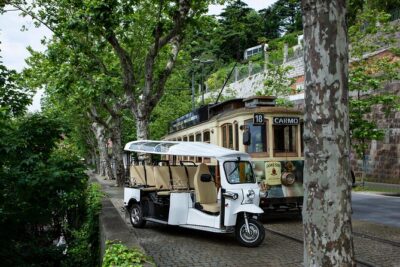 ★ 4.5Discover Porto’s Highlights on a 2-Hour Private Electric Tuk TukFrom $481,860 reviews
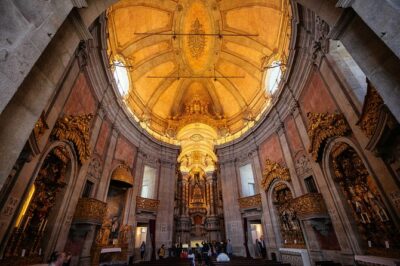 ★ 5.0Porto PRIVATE TOUR With Locals: Highlights & Hidden GemsFrom $96984 reviews
 ★ 5.0Private tour in the Douro (1 to 4 people) on a boat just for youFrom $168744 reviews
 ★ 4.5Historic Porto by Private Electric Tuk Tuk to Top LandmarksFrom $42735 reviews
 ★ 4.8Private Tour of the Historic City in a Classic Ford TFrom $40716 reviews
 ★ 5.0Porto Private Food and Drink Tasting Tour with LocalFrom $139652 reviews
 ★ 5.0Private Taxi Transfer to/From Porto AirportFrom $24649 reviews
 ★ 5.0Private tasting in the Douro (1 to 7 people) on a yacht for yourselfFrom $313559 reviews