
Reviewed · PORTO BIKE & E-BIKE TOURS
Private e-Bike Tour in Porto – Explore Riverside, Beaches & Parks
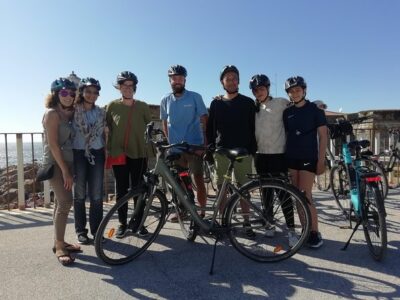
Porto by bike feels like a cheat code. In just 3 hours, you glide from Miragaia through the riverfront and into beach-and-park Porto, with a licensed local guide keeping the stops focused and fun. The route is built for variety, not just the usual center sights, and you spend real time moving between neighborhoods where Porto actually lives.
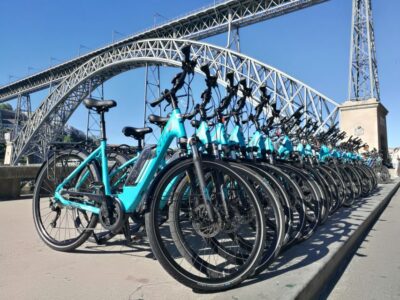
I love that the tour includes the stuff that makes this easy from minute one: e-bikes, helmets, and bottled water. I also like the mix of big-city landmarks and quieter coastline moments, from the Tram Museum to the views around Foz and Matosinhos.
One thing to consider: Porto can be crowded, and parts of the route run along active paths, roads, and tram tracks. If you are a timid rider, you may feel a bit stressed around pedestrians, scooters, and traffic.
Key highlights worth your attention
- Private, small-group feel: It is private, so it is just your group.
- Expert local guidance: A licensed guide connects what you see with Porto’s past and present.
- E-bikes make the route practical: You can handle the hills without turning the tour into a workout class.
- A coast-to-park mix: Douro river views, beach air, and multiple public parks in one loop.
- Many free stop-ins: The itinerary includes stops marked as admission-free.
- A strong finish near Ribeira: You end near the riverfront where Porto’s iconic scenes cluster.
Getting started at Biclas & Triclas, and what you actually get
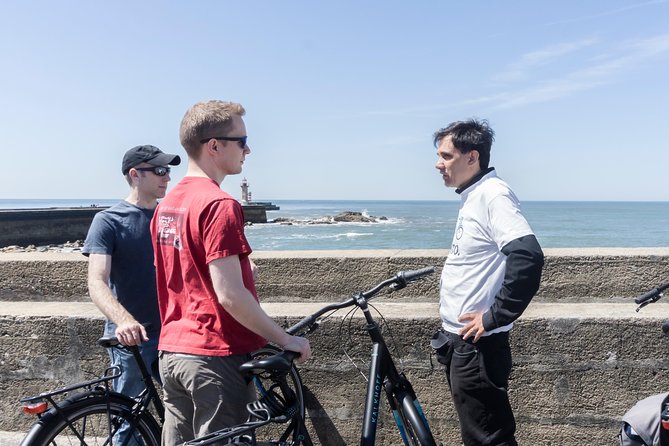
The tour meets at Biclas & Triclas – Port Rent a Bike and Tours, R. Nova da Alfândega 108 R/C, 4050-431 Porto. You start and end there, so you are not dealing with a separate pickup headache or a long walk to your return point.
Included is everything you need to ride comfortably: use of an e-bike, helmet, a local guide, and bottled water. Taxes and fees are included in the price, so the booking should feel straightforward. Also, there are souvenir photos available to purchase, but those are optional.
The tour is offered in English, and you get confirmation at booking time. It is a private tour/activity, meaning only your group participates, not a shared crowd shuffle.
You can also read our reviews of more cycling tours in Porto
Why this Porto route feels different from a walking tour
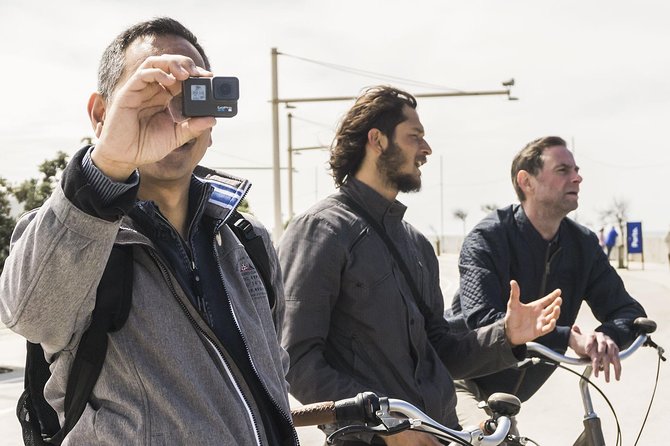
This is not a “see the top 10 monuments” itinerary. The core idea is that Porto looks totally different once you leave the tightest historic center lanes and start riding along the Douro waterfront, out toward the coast, and through major parks.
Walking is great for the old streets, but walking also traps you in hills and short viewing angles. Here, the e-bike keeps you moving at comfortable speeds, so you can cover a longer sweep of Porto without exhausting yourself before the best views show up.
That mix also matters for context. You see how different parts of the city connect, for example how river trade and transport shaped neighborhoods, and how the city grew around the water rather than away from it.
Miragaia to Alfândega Congress: cobbles, maritime change, and what the city replaced
Stop 1 is Miragaia, a picturesque riverside district known for cobbled streets, villas, and small restaurants serving typical Portuguese dishes. The value of this stop is not just the pretty streets. It is a reminder that Porto’s riverfront neighborhoods evolved block by block, not all at once.
Stop 2 is Alfândega Porto Congress Centre, and the story here is urban change. The construction is tied to a major platform built into the pier area where Customs is based, and it replaced the old Miragaia beach. In plain terms, this is Porto showing you how infrastructure reshaped shoreline life in the 19th century.
Both of these are quick photo-and-orientation moments (about 5 minutes each). You are not stuck at one place long enough to lose momentum, but you get enough context to understand what you are passing.
Tram Museum and the river-industrial link you might miss on foot
Next up is Museu do Carro Electrico (Porto Tram Museum). It opened in 1992 and sits in a former thermoelectric power station next to the Douro in Massarelos. That location is a clue that this stop is about more than trams. It is about how power and transport fed each other along the river.
This is a smart stop if you like city details. Porto’s modern charm rests on systems that worked earlier, and the museum gives you a concentrated way to connect the dots without turning the day into a full museum marathon.
Arrábida Bridge: the engineering moment with huge visual payoff
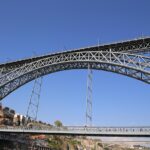
Stop 4 is Ponte da Arrábida. The bridge crosses the Douro, connecting Porto near Arrábida with Vila Nova de Gaia near Candal. When it was built in 1963, it had the largest reinforced concrete arch of any bridge in the world.
That superlative matters because you feel the scale even if you are not an engineering person. It is one of those landmarks where you get a real sense of how Porto solved river-crossing at a big-city scale.
It is also a short stop (around 3 minutes). So treat it like a quick “wow, look at that” moment, then get back on the bike for the softer coastal sections.
Compare more private Porto tours with a guide in Porto

Cantareira to Jardim do Passeio Alegre: riverside fishing roots and park calm
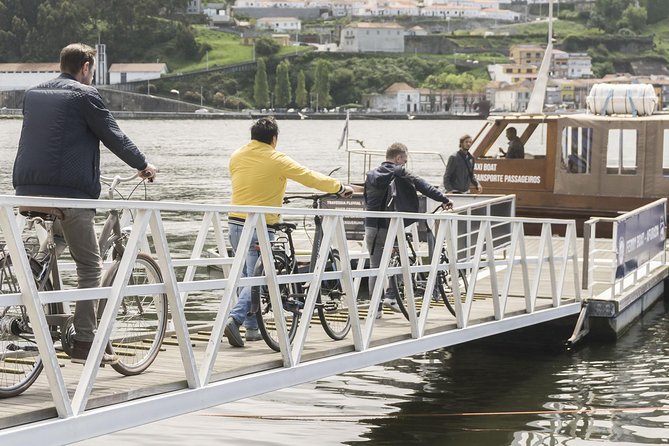
Stop 5 is Cantareira, named from an earlier time when fountains brought people to fetch water with pitchers. It has long been associated with riverside fishermen, with a harbor feel still tied to small boats and gear storage.
This stop is one of the best examples of why bike tours work. From the bike, you see the river in the same breath as the working waterfront vibe, and you get a feel for why Foz and nearby areas became so tied to coastal life.
Then you move into greenery with Jardim do Passeio Alegre, a garden in Foz do Douro with heritage value, described as a Property of Public Interest. This is a calm break, and it also sets up the Foz area correctly: Porto is not only stone and river views. It is also public gardens and open air.
Fortress São João Baptista and the lighthouse tip: the coastline framed like a lookout
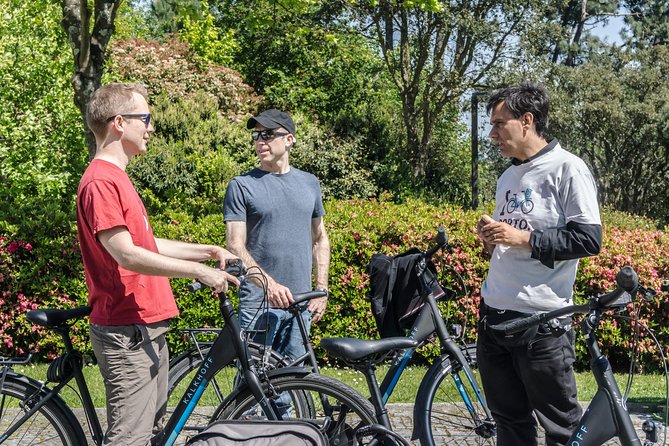
Stop 7 is Fortress São João Baptista, also known as São João da Foz Castle, in Foz do Douro. It sits in a dominant position on the Douro river bar, providing river access to Porto.
Stop 8 is Farolim de Felgueiras, a lighthouse on the right bank of the Douro near the tip of the pier. Together, these two stops give you a practical sense of coastal geography. You are seeing how Porto uses elevation and signals to manage access and safety near the river mouth.
Both stops are brief (about 2 to 3 minutes). Do not rush your photos too much. In this part of the route, the sky and water do a lot of the work for you.
Pergola da Foz, Castelo do Queijo, and Matosinhos: beaches without the all-day hassle
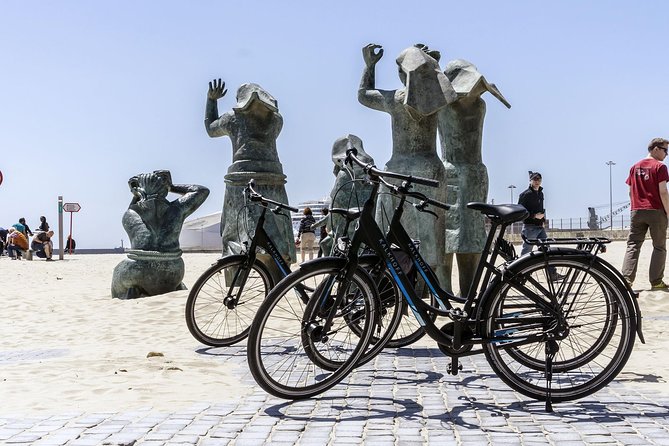
Now you are in the beach sequence.
Stop 9 is Pergola da Foz, tied to Praia da Foz and the beaches of Ourigo, Ingleses, and Luz. It is a quick stop, but it helps you understand why people come here for coastal scenery.
Stop 10 is Praia do Castelo do Queijo, a rocky-hill beach area named for a 17th-century coastal defense built to protect from North African pirates. The nickname comes from the cheese-shaped rocky hill, and you can usually read that shape instantly when you reach the viewpoint area.
Stop 11 is Matosinhos Beach, described as the largest beach with easy access from central Porto. It offers wide golden sands and waves suited to surfing.
Here is the practical part: you are getting the coastal hit, including the open-water feeling, without spending half a day commuting or stuck in beach crowds. The bike route gets you there efficiently, then your guide steers you through just enough time to take it in.
Parque da Cidade and Pasteleira: the big parks that make Porto feel bigger
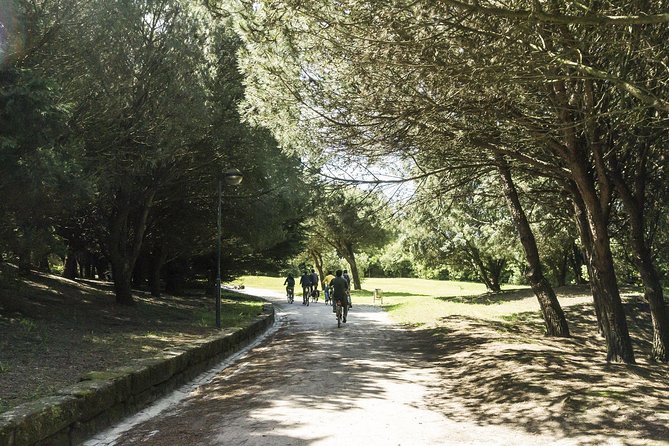
Stop 12 is Parque da Cidade, Porto’s largest urban park, covering about 83 hectares and around 10 km of paths. It was designed by landscape architect Sidónio Pardal, and it is described as an architectural landscape with lakes plus flora and fauna integrated into the city.
This is a place I think you appreciate more from a bike than on foot because you are moving with purpose. You can see scale quickly, and you get the feeling of stepping into a different pace of life.
Stop 13 is Parque Urbano da Pasteleira, a public park in Lordelo do Ouro. It extends over forest divided into two plots by Afonso de Paiva Street, with three wooden pontoons connecting areas.
These park stops are short (about 3 to 10 minutes depending on the point), so they work best if you treat them as “orientation and atmosphere.” If you want long wandering time, plan extra time later. The tour gives you a taste and a direction for what to explore next on your own.
Jardim do Cálem to Ribeira: the river returns for a dramatic grand finale
Stop 14 is Jardim do Cálem, a small garden near the mouth of the Douro with strong river views and tall black poplars nearby. It is brief (around 2 minutes), but it sets the scene for the final approach.
Stop 15 is Praça da Ribeira, one of the oldest squares in Porto, already mentioned in royal letters in 1389. This is where the city turns its face to the quay and the river again.
There is also a darker historical reference here. The area of Ribeira and its commercial connection with the Douro relates to the infamous Ponte das Barcas. In 1809, more than 4,000 people died during an onslaught of French troops. A bronze bas-relief marks the moment today.
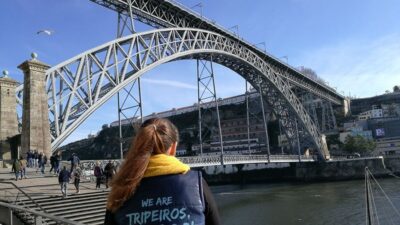
Stop 16 is the big icon: Dom Luís I Bridge. The real name is Luiz I, not D. Luís I, but locals keep the popular version. Either way, it is an ex-libris of Porto and listed in UNESCO’s World Heritage Site since 1996.
This last stretch is where the tour can feel the most “Porto big city.” You are ending near the historic core, where traffic, pedestrians, and the riverfront energy concentrate fast.
How riding in Porto feels on an e-bike, and who should do this
Porto by bike is doable. E-bikes help a lot, including for hills that would otherwise slow you down. In fact, one of the most repeated strengths in the tour experience is that it feels easier than you expect, even with riders who are not used to city cycling.
That said, this is still a city ride. You may ride along busier paths, roads, and tram track areas. You will also share space with pedestrians and scooters, so you cannot expect a wide-open countryside cycling lane experience.
If you are an experienced city cyclist who likes quick turns and steady situational awareness, you will probably feel fine. If you are a timid rider, go in with realistic expectations. Even when the route is mostly manageable, crowd density changes how relaxing it feels.
Weather matters too. The experience requires good weather, and if it is canceled due to poor weather you should be offered a different date or a full refund.
Price, timing, and real value at $71.20 for 3 hours
At $71.20 per person for about 3 hours, the value is mostly about what is included and what you avoid.
You get the e-bike, helmet, bottled water, and a licensed guide. You are also getting multiple free stop-ins based on the itinerary, which helps you keep costs stable and avoids time sinks at ticket counters.
You also gain efficiency. Instead of spending your Porto time bouncing between scattered areas via rideshare or long walks, you cover riverfront, coast, and park territory in one go. If you are short on time, that efficiency is huge.
On timing, the tour is often booked about 27 days in advance on average. That tells me it is a popular way to see a lot of Porto without wearing yourself out. If your dates are fixed, booking earlier is the easiest way to avoid scrambling.
Guides, storytelling style, and how to get more out of the stops
One of the best parts of this kind of tour is how the guide shapes your attention. The stops are short, so you want a guide who makes each one meaningful instead of just pointing.
Names that come up strongly for this route include Eduardo, Javier, Helios, Emanuel, Felipe, Joachim, and Atur. In practice, the best moments are when your guide connects what you see to Porto’s systems: river access, transport history, and how the city adapted along the coast.
A simple way to get more value is to ask a question at the first viewpoint. For example:
- At the Tram Museum, ask how Porto’s power and transport history connects to the river.
- At Ponte da Arrábida, ask what makes that bridge a turning point in the 1960s.
- At Ribeira, ask how the Ponte das Barcas story still shapes the way locals talk about the waterfront.
If your group is small, you may also have more flexibility in pacing and photo stops.
A few practical tips before you go
Wear something comfortable and keep your phone secure for short stops. You will be taking photos at water and bridge viewpoints, and the coastline wind can be real.
Bring sun protection even in mild weather. Coastal air cools you just enough to forget sunscreen until you look down and realize you got a sunburn anyway.
And if you are planning a lunch afterward, know that food and drinks are not included unless specified. This tour keeps you moving, so you will likely want a proper meal after you return.
Should you book this private e-bike Porto tour?
Yes, if you want a high-value snapshot of Porto that stretches beyond the tight center streets. This tour is especially good for you if you:
- want Douro river views plus Atlantic beach air in the same half-day
- like parks and waterfronts, not just monuments
- want an easier ride thanks to e-bikes and a licensed guide
Skip or reconsider if you:
- are very new to city cycling and think crowds and traffic will make you anxious
- only want the deepest historic-core walk around Ribeira and nearby squares
If your goal is to see more of Porto than the usual center loop, this is a strong pick. You end in the right place, near the Ribeira scene, and you will likely feel ready to explore the rest of the city at your own pace.
FAQ
How long is the private e-bike tour in Porto?
It runs for about 3 hours.
What does the tour cost?
The price is $71.20 per person.
What’s included in the price?
The tour includes taxes and fees, use of an e-bike, helmet, a local guide, and bottled water.
Is food included?
Food and drinks are not included unless specified. You should plan to buy your own.
Is this tour private?
Yes. It is a private tour/activity, so only your group participates.
Where do you meet for the tour?
The meeting point is at Biclas & Triclas – Port Rent a Bike and Tours, R. Nova da Alfândega 108 R/C, 4050-431 Porto, Portugal. The tour ends back at the meeting point.
Do you have to speak Portuguese?
No. The tour is offered in English.
What about kids?
Children up to 5 years of age must use a child seat.
What’s the cancellation policy if weather is bad?
Free cancellation is available up to 24 hours in advance for a full refund. The experience requires good weather, and if canceled due to poor weather you should be offered a different date or a full refund.
More Cycling Tours in Porto
More Tours in Porto



More Tour Reviews in Porto

Keep comparing: recently reviewed experiences around Porto







Porto Bike & E-Bike Tours, compared.
 ★ 4.8City Highlights 3-Hour Guided Electric Bike TourFrom $513,092 reviews
 ★ 5.03-Hour Old Town & Riverside Bike Tour – Guided ExperienceFrom $47481 reviews
 ★ 4.9Guided 3-Hour Best of Tour by SegwayFrom $78479 reviews
 ★ 5.02-Hour City Highlights Segway Tour – Guided ExperienceFrom $78331 reviews
 ★ 4.6Riverside Panoramic E-Bike TourFrom $51312 reviews
 ★ 4.9Highlights in 3 Hours E-Bike TourFrom $53290 reviews
 ★ 4.83-Hour Bike TourFrom $57260 reviews
 ★ 5.0Porto Highlights in 3 Hours E-Bike Tour – Historical, SightseeingFrom $59166 reviews
Browse the lists this tour appears in