
Reviewed · PRIVATE PORTO TOURS
Porto private night Tour, discover the most iconic attractions
Porto looks different after dark. This 3-hour private night tour strings together Porto’s biggest landmarks, plus smart detours for views, so you can see a lot while the streets feel calmer. You’ll roll through the city in a comfortable vehicle, then hop out for short, focused stops at places that look great under night lighting.
I love the onboard Wi-Fi and the way the guide turns each stop into a clear story, not just a photo stop. I also love the private format, where the pacing can fit your group, including quick picture breaks and small reroutes if the evening weather changes.
One thing to plan for: several top sights list tickets not included, so if you want to go inside (tower, churches, bookstores, Bolsa), you may need to buy entry separately and accept less time on the rest.
Key highlights worth planning for
- Short time, big coverage: quick exterior stops plus driving time in a comfort-first vehicle.
- Stop-and-explain guiding: history moments tied to what you can actually see right now.
- Iconic night views: bridges, river viewpoints, and the Gaia side are built in.
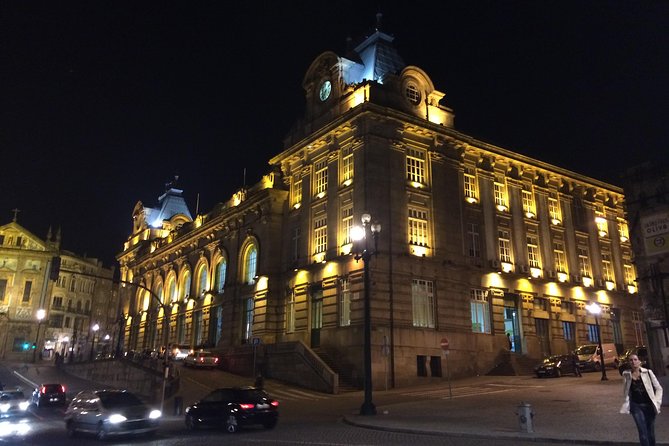
- Photo-friendly classic interiors: places like São Bento Station and Café Majestic are designed for nighttime wandering.
- A guide you can ask questions: the experience is built around interaction, not a lecture.
Why this Porto night tour is a smart way to start
A night in Porto has a trick: the city’s famous spots are much easier to enjoy when you’re not fighting for position in daylight queues. This tour is built around that idea, using driving time to stitch together areas that are far apart on foot.
At about 3 hours, the goal isn’t deep museum time. It is getting you oriented fast, showing you the “must-see” architecture and viewpoints, then pointing you toward what to revisit on your own later. If you like your travel with structure and breathing room, this works well.
The private setup matters too. You’re not packed into a big group with hard edges on timing. Instead, you can ask questions as you go, and the guide can adjust the moment-by-moment flow around your group.
Compare more private Porto tours with a guide in Porto
Meeting point and what you get before the first stop
You meet at Praça da Liberdade 19, 4000-322 Porto, and the tour ends back there. Pickup is offered from downtown Porto and Gaia hotels and B&Bs, so you can skip the “how do we get there at night” puzzle.
The vehicle setup is part of the value. You get Wi-Fi onboard, bottled water, refreshments, and a relaxing ride style, plus personal accident and liability insurance. Even if you mostly care about the sightseeing, that comfort piece makes the evening feel easier, especially if it’s cool or rainy.
Also, this is listed as English with a mobile ticket. The experience is designed so you can show up, scan, and go without complicated steps once you’re on-site.
Avenida dos Aliados and D. Pedro Square: Porto’s grand entrance
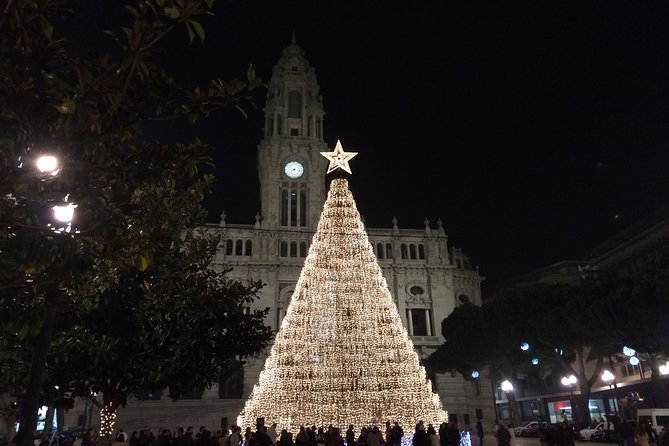
The tour begins with a wide avenue lined by 1920s to 1940s-era buildings, closed on the south by the Cardosas building and framed toward the north by Porto Town Hall. This section is your quick primer on the city’s mix of grandeur and older bones.
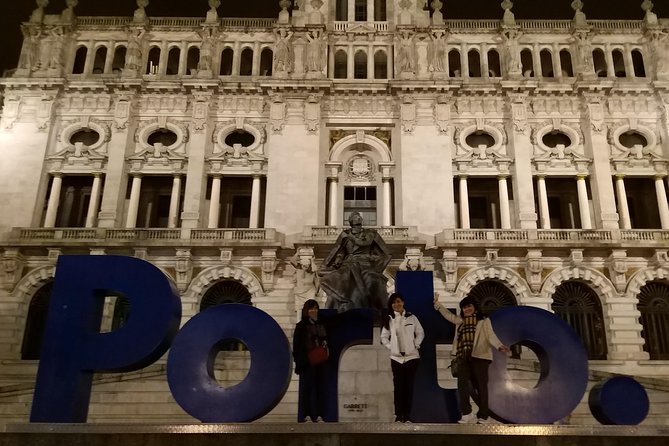
From here, you get the statue of D. Pedro IV, the Liberator, in D. Pedro Square. At night, statues like this feel different, more like landmarks than background. It’s a good moment to take in the scale of the city center, so later bridges and towers make more sense.
What I like about starting with architecture like this is that it sets a mental map. After you’ve seen the “big city” streets, the next medieval and religious stops feel like layers instead of random scattered sights.
Mercado do Bolhão and Praça da Batalha: the city’s pulse and its scars
Next up is Mercado do Bolhão, Porto’s emblematic market, dating from 1850 with a distinctive two-floor neoclassical structure. Even if you don’t go inside, you’ll get the feel of why markets matter here: they organize daily life, not just tourism.
The market sits in a compact block with streets named Fernandes Tomás, Alexandre Braga, Formosa, and Sá da Bandeira, and the focus is on fresh products with specialized stalls for fish, butchers, vegetables, and florals. At night, the market area can feel lively without being chaotic, and it’s an easy stop to photograph the historic stonework and entrance details.
Then you shift to Praça da Batalha, one of the most rooted squares in Porto. The name points to a historic defeat around the 10th century, when Porto was overpowered by Almançor’s forces, and the square became urbanized around 1861. You also pass Teatro São João, inaugurated 1798, and remember its dramatic turn in the April 11 to 12, 1908 fire.
This stop is a good reminder that Porto didn’t build its identity overnight. It grew, lost, rebuilt, and kept going.
Muralha Fernandina: the old wall that still changes your view
The Muralha Fernandina was a defensive wall project that began in the 14th century under D. Afonso IV, built to handle the city’s expansion. Even though much of it was close to complete around 1370, the name comes from its eventual completion under D. Fernando in 1409.
By the 18th century, it was no longer military-critical, and parts were demolished. What remains today is a reminder that Porto’s “old” is not just pretty buildings, it’s also infrastructure that shaped where streets went and where people could live safely.
This is a short stop, but it’s the kind that helps you read the city. Once you know the wall existed to control growth, the street shapes feel more logical instead of accidental.
You can also read our reviews of more evening experiences in Porto






Cathedral of Porto and São Bento Station: two very different kinds of beauty
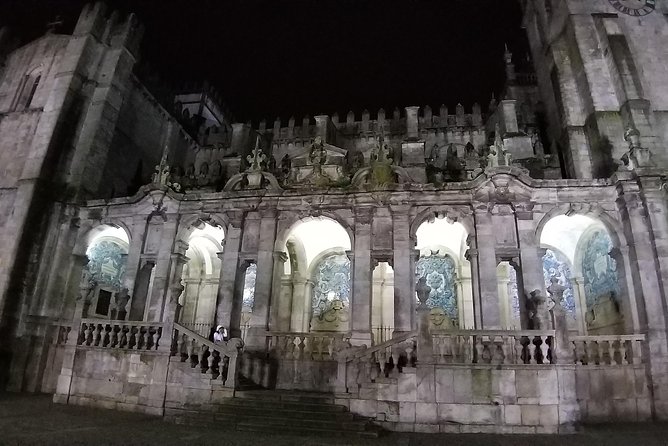
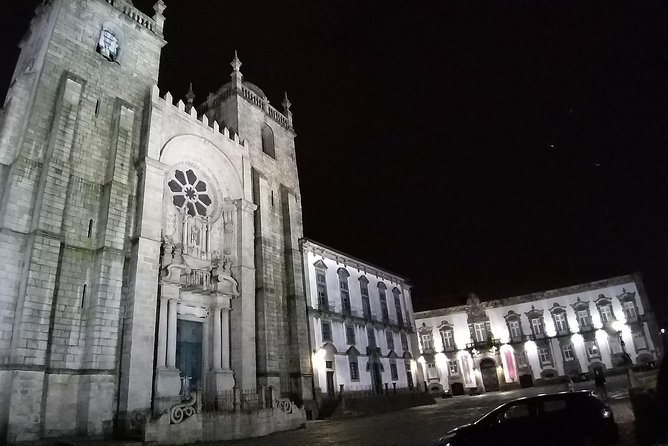
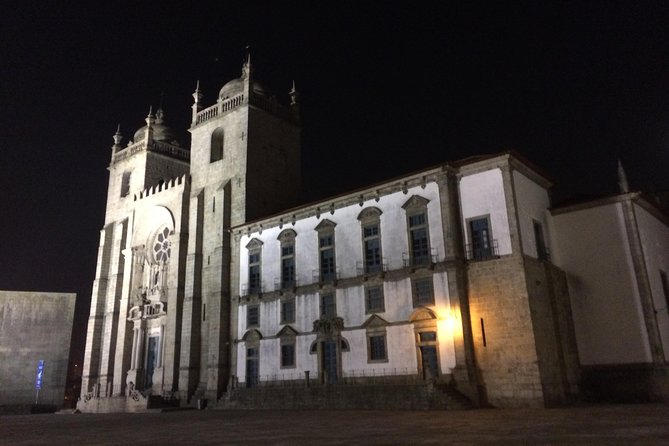
At Catedral do Porto, you’re looking at a structure with a long timeline: started in the 12th and 13th centuries, expanded and renovated over time, and finalized in the 20th century while keeping a medieval cathedral core.
If you want to go inside, note that admission is not included. Still, even from the outside, the cathedral signals the city’s long religious importance. Inside highlights you can plan around include the Gothic Chapel of St. John the Evangelist and its cloister, plus the Chapel of the Blessed Sacrament with its silver altar.
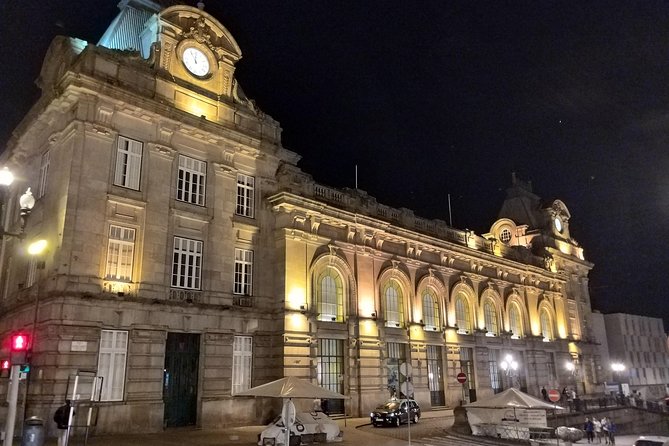
Then you head to São Bento Railway Station, and this is one of the most satisfying “included” moments. It’s free, and the station’s vestibule is filled with about 20,000 painted tiles by Jorge Colaço showing the evolution of transport and everyday Portuguese life through history.
At night, the station can feel like a museum that happens to be attached to public transit. If you love visual storytelling, it’s one of the stops you’ll remember even if you don’t think you’re a tile person.
Café Majestic and the Galerias Palladium clock: classic Porto glamour
Café Majestic opened in 1921 and is strongly tied to Porto’s Belle Époque era. The building’s Art Nouveau style, with marble, gilded mirrors, and intricate woodwork, makes it a place you understand even before you step fully inside.
This stop is a great “reset” after church and cathedral seriousness. It’s also a useful photography moment: the interior details and façade feel cinematic after dark.
A short stroll nearby brings you to Relógio das Galerias Palladium, an ornate clock with a carillon and four statues. They emerge and parade every three hours, representing São João, Infante D. Henrique, Almeida Garrett, and Camilo Castelo Branco.
If your timing lines up, this becomes pure Porto theater. Even if it’s not happening while you’re there, the clock still works as a night anchor.
Rivoli Theatre area and the University-built streetscape
As the tour continues through the city center, you’ll also pass the Rivoli Theatre area. The theatre was inaugurated in 1913, later adapted and modernized, and then reopened as the Rivoli Theatre in 1932 for a mix of opera, dance, theatre, and concerts. It shifted ownership to the Porto City Council in 1989, closed in 1992 for remodeling, and completed major work by 1997.
This is another good “context” stop. Porto’s night isn’t just old stones, it includes cultural institutions built for modern urban life.
Nearby, you’ll see a neoclassical building designed by Carlos Amarante and financed by a tax on wine in 1803. In 1911, it housed the Faculty of Sciences, and today it connects to the Rectory and Museum of Natural History and Museum of Science of the University of Porto.
If you’re the type who likes to understand what makes a city tick, these education and arts settings help.
Carmo and Carmelitas plus Casa Escondida: churches with a twist
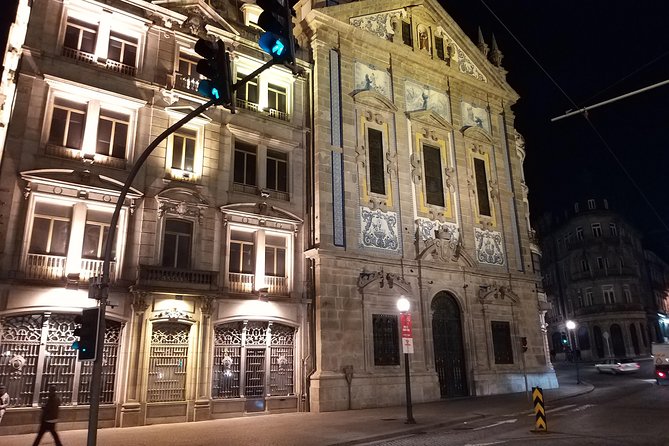
Two baroque churches anchor this part of the route: Igreja do Carmo and Igreja das Carmelitas. The standout visual here is the azulejos on Igreja do Carmo’s exterior and the ornate façade quality on the Carmelitas side.
But the real story moment is the Casa Escondida, the Hidden House wedged between the two churches. In a dense historic area, the trick wasn’t only building up. It was building around constraints, and this little space shows creative problem-solving in stone and brick.
Admission is listed as free for this stop area, and that matters. You can take your time looking at exterior details without worrying about separate entry costs.
Clérigos Tower and Livraria Lello: Porto’s most famous façades
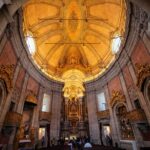
If you want “Porto postcard” energy, this is where it hits. Torre dos Clerigos, built in the first half of the 18th century by Nicolau Nasoni, is a Baroque landmark and it’s designed for a panoramic payoff. The climb is 240 steps, and admission is not included.
It also has a modern pop-culture connection. The tower appeared in the 2021 Hollywood blockbuster Suicide Squad, which makes it easier to spot if you’ve seen the film.
Right after that, you visit Livraria Lello, opened in 1906. The façade mixes Art Nouveau with Neo-Gothic details. Inside, the library has painted plaster meant to imitate wood, plus a dramatic staircase linked to an upper floor, noted as early reinforced concrete work in Porto. You’ll also see a large stained-glass skylight with a monogram and motto.
Again, admission is not included, so treat this as a walk-by moment unless you plan to purchase entry.
Igreja de São Francisco and the interior you probably want to see
The Igreja de San Francisco is Porto’s major Gothic temple, started in the 14th century, then shaped by later golden Baroque interior work from the 17th and 18th centuries. The church is famous for carved woodwork, and you’ll also want to look for features like the Tree of Jesse and the catacombs.
Admission is not included, but the stop is still worthwhile because the church’s exterior and positioning give you a strong sense of what kind of interior transformation happened over time.
This is the kind of place where, even if you skip inside, you’ll understand why Porto became known for ornate religious art.
Bolsa Palace and the world of commerce in an elegant package
Next is Palácio da Bolsa, a National Monument and the property/place of the Commercial Association of Porto. The building is neoclassical, designed by Joaquim da Costa Lima, built in 1842, and it sits on the former site of the Convent of San Francisco, which was destroyed by a fire during the Siege of Porto.
The highlight is the Arab Room, and admission is not included. Even if you don’t go in, the presence of this kind of civic architecture next to churches and markets tells you what Porto valued: trade and culture were never separate here.
The bridge sequence: Porto and Gaia in one evening
This part of the tour is the reason night coverage feels efficient. Bridges connect viewpoints, and you get to see the city in layers.
You’ll pass the old suspension bridge area tied to D. Maria III, inaugurated 1843 by a French company. It was deactivated after about four years because people felt insecure crossing it. Today only two stone pillars shaped like obelisks remain.
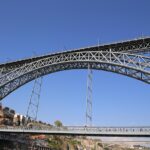
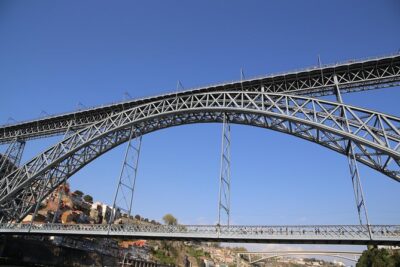
Then you move to Ponte D. Luís I, created in the late 19th century as a replacement for the suspension bridge. It’s credited as the largest wrought iron arch in the world, and it forms part of what makes the Historic Center UNESCO-listed and unforgettable from river level.
You’ll also see Ponte D. Maria Pia, Gustave Eiffel’s first masterpiece, inaugurated in 1877, operating for 114 years until the São João Bridge replaced its use. The design is a biarticulated arch supporting a single track rail board. Admission is listed as free for this stop, so you’re likely there for viewing and understanding the engineering, not paying to enter.
Arrábida Bridge and the forts: engineering meets defense
Further on, you’ll reach the Arrábida Bridge, designed by Edgar Cardoso with an extension of 270 meters. It was, for some time, the longest reinforced concrete bridge in the world and sits about 70 meters above average water level. Bronze sculptures top the large pillars, adding an art element to industrial infrastructure.
Then the route turns to coastal protection with Fortress São João Baptista, built at the end of the 16th century to protect the coast and the entrance to the Douro. Modern fortress add-ons arrived in the 17th century, and the access gate is from the 18th. Admission is not included.
After that is Castelo Do Queijo, the Cheese Castle, which is actually São Francisco Xavier Fort built in the 17th century to protect against pirates of North Africa. It’s named for its rocky hill shape. Admission is not included here too.
These stops are excellent if you like the idea that Porto’s story includes defense, not just elegance.
Jardim do Morro, Serra do Pilar, and the best “pause and breathe” moments
Between heavy sights, you get calmer public spaces. Jardim do Morro is a hill garden with panoramic views over the city and Douro area, designed as a tranquil spot with wide pathways and lush greenery. Admission is free.
Then there’s Mosteiro da Serra do Pilar in Vila Nova de Gaia. It belongs to the Order of St. Augustine, construction began in 1538, and the church and cloister’s circular shapes make it a standout in classical European architecture. It’s classified as a national monument and became UNESCO-listed in 1996 along with the Historic Center and Luís I Bridge. Admission is listed as free.
This is the area where the night timing matters most. You’re getting views while the city lights reflect off water and stone.
Leixões Port, She Changes, and Serralves: Porto after the classics
Not everything on this tour stays in the medieval core. You’ll also see modern Porto signals.
You’ll encounter She Changes (Anemone), a sculpture by Janet Echelman made from a moving fishing net structure influenced by wind. It looks like a huge anemone drifting with sea currents.
Then there’s Leixões Port, tied to cruise traffic and the new cruise pier opened in April 2011. The port’s growth is part of the story, including big passenger and ship count changes after the pier opened.
Finally, Serralves comes in, including the Art Deco Casa da Musica? (Casa da Musica is separate), and the Serralves complex itself: the Art Deco House and the Serralves Park with gardens and forest across 18 hectares. The park is designed by Jacques Greber, and the estate hosts the Museum of Contemporary Art and the art deco house. This is one of the spots that helps you understand contemporary Porto beyond postcards.
Casa da Música and Praça de Mouzinho de Albuquerque: music and monuments
Casa da Música is Porto’s main concert hall, designed by Rem Koolhaas and inaugurated in 2005. Admission is listed as free for the stop.
Then you reach Praça de Mouzinho de Albuquerque, dominated by a monumental 45 m high monument to the Heroes of the Peninsular War, inaugurated in 1951. The monument includes an obelisk and sculpture groups representing the union of Portuguese with the English and victory against French Napoleonic armies.
This is a good end-cap for the tour because it pulls the story toward shared national history rather than only local architecture.
Optional extras: Fado and Port wine, timed to start your next night
Two optional add-ons are available, but they are not included in the standard price.
The first is an optional Fado show with port wine, listed for 1 hour, scheduled daily at 18:00 and 19:30. It includes port wine tasting, and the ticket price is €20 to €26. If you choose it, note the tour start moves earlier by about 2 hours.
The second optional add-on is a Port Wine Cellars tour, exclusive Dona Antónia, priced €32 to €41, lasting 1h30 with tasting of 5 port wines. It includes the story of Dona Antónia Adelaide Ferreira and is also described as a tour that starts about 2 hours earlier.
If you want a simple evening with no schedule pressure, stick to the main night tour. If you’re committed to tasting and live music, plan the add-on early so you don’t end up split between timing conflicts and long transitions.
Price and value: what $184.84 buys you in Porto at night
At $184.84 per person for roughly 3 hours, this isn’t a bargain-basement city walk. But you are paying for three things that matter at night.
First is the private vehicle comfort. You get pickup options across central Porto and Gaia, plus onboard Wi-Fi, water, and refreshments.
Second is the efficient routing. The route covers central landmarks, major churches, famous viewpoints, and multiple bridges, all in a time window that would be a stretch on foot.
Third is the guided interpretation. With history tied to what you can see, you leave with a mental map, not just a set of photos.
One cost consideration: some of the biggest “want to go inside” stops list tickets not included. If you plan to enter many of them, budget extra for that.
Should you book this Porto private night tour?
Book it if you want a guided, low-stress night orientation that hits Porto’s iconic sights and the bridge views without tiring you out. It’s especially strong for first-timers who want the city’s structure explained while the evening light does the work for your photos.
Skip it if you already know Porto well and you only care about one or two interiors. With ticketed stops not included, a “deep inside the museums” approach could feel constrained in a 3-hour window.
If you’re traveling as a couple, a small family, or a group that likes questions and flexible pacing, this is a very practical way to get your bearings fast. And if the evening weather turns messy, you’ll still have the advantage of vehicle comfort plus a guide who can keep the evening moving.
FAQ
How long is the Porto private night tour?
It’s listed at about 3 hours.
Where does the tour start?
The meeting point is Praça da Liberdade 19, 4000-322 Porto, Portugal.
Is pickup included?
Yes, pickup is offered from downtown Porto and Gaia hotels and B&Bs.
Is Wi-Fi available during the tour?
Yes, the tour vehicle includes onboard Wi-Fi.
What language is the tour offered in?
The tour is offered in English.
Are attraction tickets included in the price?
Some stops list admission ticket free, while others list admission ticket not included. If you want to enter places with not-included tickets, you will likely need to purchase those separately.
Is this a private tour?
Yes. It’s a private tour/activity, so only your group participates.
Are Fado and Port wine tours included?
No. They are listed as optional add-ons. Fado with port wine is an optional activity, and the Dona Antónia Port wine cellar tour is another optional activity.
Can I cancel for a full refund?
Yes, the experience offers free cancellation. You can cancel up to 24 hours in advance for a full refund.
What if the weather is poor?
It says this experience requires good weather. If it’s canceled due to poor weather, you’ll be offered a different date or a full refund. Service animals are allowed.
More Private Porto Tours


More Tours in Porto





More Tour Reviews in Porto
Keep comparing: recently reviewed experiences around Porto

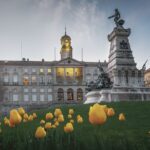



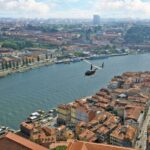

Private Porto Tours, compared.
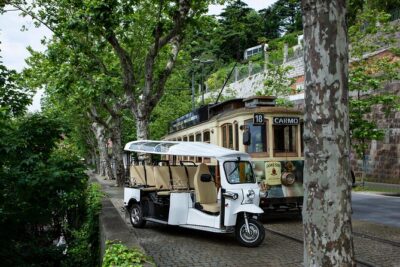 ★ 4.5Discover Porto’s Highlights on a 2-Hour Private Electric Tuk TukFrom $481,860 reviews
 ★ 5.0Porto PRIVATE TOUR With Locals: Highlights & Hidden GemsFrom $96984 reviews
 ★ 5.0Private tour in the Douro (1 to 4 people) on a boat just for youFrom $168744 reviews
 ★ 4.5Historic Porto by Private Electric Tuk Tuk to Top LandmarksFrom $42735 reviews
 ★ 4.8Private Tour of the Historic City in a Classic Ford TFrom $40716 reviews
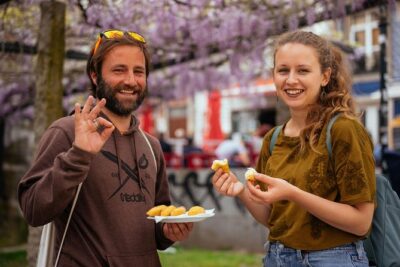 ★ 5.0Porto Private Food and Drink Tasting Tour with LocalFrom $139652 reviews
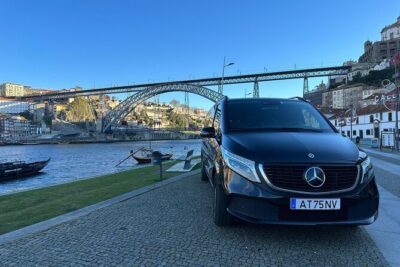 ★ 5.0Private Taxi Transfer to/From Porto AirportFrom $24649 reviews
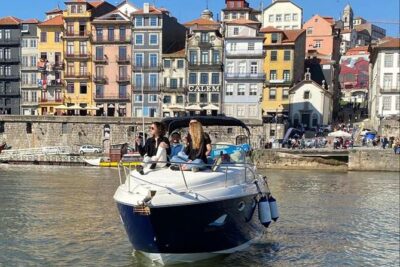 ★ 5.0Private tasting in the Douro (1 to 7 people) on a yacht for yourselfFrom $313559 reviews
Browse the lists this tour appears in